13-yr-old takes her own life after being raped, writes a letter to warn others


We’ve all been affected by bullying in one way or another.


 We may have been victims, seen someone being bullied or even been the bully ourselves. Many children, teens and even adults are subjected to psychological and physical bullying on a daily basis that makes their lives a living hell. Cassidy Trevan from Melbourne, Australia knew all too well what that was like. She had been bullied for a long time. The bullying was mostly pyschological, but had also turned physical a couple of times.


She was called terrible names, attacked at school and on the internet. Even her family home was vandalized.
It got so bad that she could no longer go to school. It was just too much. Despite conversations with the bullies, things didn’t improve.
After a whole term away from school and with support, she was ready to give school another try. She started off with two days a week to get used to it.
The girls who had treated her badly apologised. They even wanted to be friends with her now. They asked if she wanted to go to a festival with them.
Of course she wanted to. She had been excluded for so long that even though the girls had been mean to her before, her need for friends outweighed that.
What Cassidy didn’t know was that the girls had a plan more outrageous than anyone could imagine.
The girls took Cassidy to a nearby house where they’d arranged for two older guys to rape her.
The girls sat outside and waited while the boys took turns raping Cassidy. She was 13 years old.
Cassidy reported the incident to the police, but unfortunately the case was dropped due to a lack of evidence. All of those involved walked free.
Cassidy’s mom, Linda, transferred her to a different school, and they even moved, but the bullies always found a way to get at her. They attacked her in shops and even called her mom and asked to talk to her.
Linda did everything she could, but she still had to watch her daughter deteriorate. Eventually, Cassidy could hardly get out of bed in the morning.
In December 2015, she took her own life.
After her suicide, Linda found a letter that Cassidy had written. A letter that everyone should read. A letter to all those who bully. A letter to everyone who has been bullied.
Here’s what she wrote:
“I was a student at (school name omitted) and I was raped by some of the students who still attend that school. I know this already probably sounds like attention-seeking but it’s honestly far from it. I have many reasons for doing this which I’ll also explain.
My aim is to warn other people (students mostly but also parents) about what happened because I’m worried if they could do it to me they could do it to other kids like me, or at least try to. You actually have the power to stop this from happening. Remember the people who did this to me were school students at (omitted), it’s hard to believe, I know. But it’s true.
I’m not doing this for revenge to those students that raped me, set up the rape, bullied me about the rape, teased me about the rape or anything like that. I’m also not doing this for attention seeking like I mentioned earlier, I want to make that clear.
I’m doing this because over 1500 students years 7-12 are currently enrolled at the school and they need to be warned. I feel because of what happened to me, and because the staff at the school did nothing to help me (which I’ll talk a bit more about later). It’s now my duty to warn you all and to make you aware of what happened. (Not just what you may have heard around school but what actually happened.)
But I’m also doing this for myself. I want to finally after 1 and ½ years be left alone. It’s surprising just how many students at (omitted) have heard stories of me and weirdly enough still get told stories of me to this day. I still continue to get students I’ve never met contacting me Facebook calling me a slut. I’ve moved schools, I’ve moved house and still I’m being contacted and bullied. I can’t stop people from spreading rumours, but at least I could try and spread what really happened seeing as it’s still being talked about anyway. But as I said this honestly is more so for students who are unaware of this and are in danger of those students.
My name is Cassidy Trevan, and I was raped.
If anyone every tries this on you trust me it’s worth fighting! Fight! If you don’t you’ll regret it for the rest of your life like I do. You can do it.
Be careful. Be warned. Be safe.”
The letter was published by Australian Channel 9.
The death of one Young person due to bullying is one death too many.
Nobody should be made to feel so bad that they believe that the only way out is to take their own life.
We have to work together. Students, parents, teachers, everyone needs to work to bring this to an end.
Nobody should have to feel alone.
Linda’s grief will never go away and her daughter will never come back.

Seattle Becomes First City to Cut Ties With Wells Fargo Over DAPL, Just Hours After Army Corps Grants Final Permit

Seattle Becomes First City to Cut Ties With Wells Fargo Over DAPL, Just Hours After Army Corps Grants Final Permit


Seattle City Council has voted to divest from Wells Fargo over the bank's role as a lender to the Dakota Access Pipeline (DAPL) and other business practices, including its financing of private prison companies, and a customer fraud case where employees opened as many as two million fake accounts.


The unanimous decision on Tuesday was met with cheers and a standing ovation from the crowd as Seattle became the first city in the nation to sever its ties with the San Francisco-based banking giant in protest of the controversial DAPL.
The Socially Responsible Banking ordinance directs city officials to end Seattle's contract with Wells Fargo once it expires in 2018 and to not make new investments with the bank for three years.
"The example that we have set today can become a beacon of hope" for activists across the country, said Councilmember Kshama Sawant, one of the co-sponsors of the legislation.


Wells Fargo contends that it is one of 17 involved in financing the DAPL. Wells Fargo has $120 million in a $2.5 billion credit agreement funding the pipeline project and said it is obligated to carry out the agreement, according to the Associated Press.
"While we are disappointed that the city has decided to end our 18-year relationship, we stand ready to support Seattle with its financial services needs in the future," Wells Fargo said in a statement.
Approval of the measure occurred just hours after the U.S. Army Corps of Engineers granted Energy Transfer Partners the final easement to drill under the Missouri River and finish the $3.8 billion project.
The Corps followed instructions from President Donald Trump, who signed two executive actions to advance the DAPL and the Keystone XL.
The completed 1,172-mile DAPL would carry oil from the Bakken formation in North Dakota to Gulf Coast refineries and export terminals via Patoka, Illinois. Its path crosses the Missouri River, which is the primary drinking water source for the Standing Rock Sioux reservation. 
For months, the tribe and fellow Water Protectors have been trying to block construction of the DAPL. Protests have drawn thousands of people to Standing Rock. Hundreds of demonstrators still remain at the protest camps and thousands of U.S. military veterans have committed to returning to Standing Rock to continue the fight.
Pipeline opponents have urged banks to stop financing DAPL construction and have called on bank customers to pull money out of their accounts.
Olivia One Feather, a member of the Standing Rock Sioux tribe, told Seattle City Council, "When big cities such as this do the right thing, it sparks hope in the world."
"It's going to be a mixed blessing and timely at the same time," Lakota Tribal Member and DAPL opponent Matt Remle told Capitol Hill Times about the Council's vote in the wake of the Corps' decision.


Xiaomi Debuts Magical Mi Mix

Xiaomi Debuts Magical Mi Mix


Xiaomi on Tuesday fired another shot in the shrinking bezel wars, as it announced a smartphone with a front that's more than 90 percent display.
The Mi Mix is a 6.4-inch phone that's stylishly crafted by French designer Philippe Starck. It sports a feature set that indicates Xiaomi wants to compete at the high end of the smartphone market.
"For many years, Xiaomi has had a reputation of copying designs and branding from Apple and Samsung," said Ross Rubin, principal analyst at Reticle Research.
"This phone breaks with those designs," he told TechNewsWorld.
"One factor for success is trying to get the greatest possible screen area into the smallest possible footprint," Rubin said. "This design comes close to the ideal of an all-screen phone."

The Mi Mix has a screen-to-body ratio of 91.3 percent. That compares to 67.7 percent for Apple's iPhone 7 Plus.

Real Estate Grab

To expand the Mi Mix's display, Xiaomi grabbed the real estate at the top of the phone occupied by the front-facing camera, ear speaker and proximity sensor.
It did that by moving the front-facing camera to the bottom of the phone, and replacing the ear speaker with a piezoelectric speaker that uses the metal frame of the phone to generate sound. It also replaced the infrared proximity sensor found on most phones with one that uses sound.
The proximity sensor turns off a smartphone's display as the device approaches the ear. Most phones use an infrared sensor at the top of the phone to do that. The Mi Mix uses ultrasound waves and software to do it.
"We use the sound transmitter that's already inside the phone," explained Guenael Strutt, vice president of product development at Elliptic Labs, maker of the ultrasound technology, which it calls "Inner Beauty."
"The sonic wave echos off the head, is picked up by a microphone, and the data is processed by our algorithms inside the phone," he told TechNewsWorld. "We use components in the phone to detect the head -- we don't have to add a new sensor."
Using sound to detect proximity also avoids issues that make infrared sensors unreliable from time to time, such as weather conditions or skin and hair coloring.

Top-Shelf Play

In addition to its eye-catching display, the Mi Mix has a 16-megapixel camera with phase-detect auto focusing, a generous 4,400 mAh battery, two SIM slots and a Snapdragon 821 processor. It supports high-definition audio with a 192 Hz/24-bit DAC chip, which users can listen to through a standard headphone jack.
Although the Mi Mix is officially a concept phone, Xiaomi will start selling it in China next week. Models with 4 GB of RAM and 128 GB of storage will be priced at US$516, and those with 6 GB of RAM and 256 GB of storage will sell for $590.
"Xiami lost a lot of traction in China as Vivo and Oppo strengthened their position in the lower end, and Huawei and Apple took the high end," said Carolina Milanesi, a principal analyst at Creative Strategies.
"I see the new Mi Mix concept phone as an attempt by Xiaomi to recapture the higher end of the market and reposition itself as an innovator," she told TechNewsWorld.
Xiaomi already is a top global contender because of its performance in China, and it wants to challenge Huawei in the West as best-performing Chinese brand.
"If this phone really goes up for sale in the West, it might jump ahead of the iPhone in terms of sexiness and design appeal," Newzoo CEO Peter Warman told TechNewsWorld.

Just the Beginning

It's unlikely the Mi Mix will be made for the mass market, though, in Milanesi's view.
"Chinese consumers love large screens, and the quality of the display looks fantastic," she said, and "$520 is in line with their pricing strategy of delivering a high-end experience at an affordable price."
That said, "it will be interesting to see what supplies will be, as I have a feeling that these phones are more focused on revamping brand than growing sales," Milanesi added.
Xiaomi might be wise to sell as many Mi Mixes as the market will bear as fast as it can before competition heats up.
More designs like the Mi Mix will start appearing in the next 12 months, said Daniel Matte, an analyst at Canalys.
"This is an indicator of where things are going. We'll see a lot of bezel-less designs in the next year," he told TechNewsWorld. "Xiaomi is one of the first to do this, but there will be many more to come.
Conspiracy Theories in the Information Age, Part 1

Conspiracy Theories in the Information Age, Part 1

One of the most volatile conspiracy theories in recent times ended with a whimper last month, when Republican presidential candidate Donald Trump made the terse statement, "President Barack Obama was born in the United States. Period."
Though birthers may be with us always, it seems that many have turned their attention to other potentially scandalous topics -- and they need look no further than the place most conspiracy theories are born these days, the Internet.
Scientists recently made a discovery that might explain why Trump's search for President Obama's "real" birth certificate resonated with his supporters -- those most drawn to his promise to "make America great again."
Highly stressed people are more likely to believe in conspiracy theories, according to research published this spring in the journal Personality and Individual Differences.
Based on the responses of 420 U.S. adults surveyed, stress and discontent correlated with a higher likelihood of belief in conspiracy theories ranging from 9/11 being an inside job to the moon landing being produced on a Hollywood set, researchers found, regardless of the participants' social status.
That offers some insight into why some people are more likely to believe, but it does not explain why they push away a preponderance of evidence in favor of the generally accepted answers to questions most people don't even ask.
There always have been conspiracy theories, noted pop culture expert Paul Levinson, a communications professor at Fordham University, who pointed to all the wild ideas that emerged in the aftermath of the JFK assassination.
Social media have fanned the flames, making conspiracy theories more likely to spread, he said.
"Anyone can write anything, and it can be viewed by millions in the blink of an eye on Twitter. Millions can, in turn, easily retweet the comment or image or link," Levinson told TechNewsWorld.

At the Intersection

One of the most popular conspiracy theories -- one that's likely to outlive this generation and the next -- concerns the untimely death of Princess Diana in a 1997 automobile accident. That event occurred squarely at the intersection of two eras, spinning one of the first major series of conspiracy theories of the Information Age.
Suspicious circumstances surrounding the incident intrigued the world. Back then, newspapers were still alive and well, birds were the only ones tweeting, and posting meant sending mail.
Author and self-described Diana fanatic Roman Clay recalled how old-school TV and print media coverage of the princess' death focused on certain details and missed many others.
Clay was surprised by the common perception that Diana had died immediately in the tunnel, as well as by the many other details that generally were unknown -- for example, that it took 108 minutes to "rush" her to the ER, and that she passed away due to internal hemorrhaging.
"There were a few writers who questioned the official report and wrote investigative books on Diana's death, but they received very little coverage in mass media," Clay told TechNewsWorld.
So Clay, using the freedom fiction allows to fill in the blanks, wrote Death of the Queen of Hearts to publish his own theory and encourage more people to question the official line.
Coverage of the princess' death certainly would have been a lot different had it occurred a decade or so later. These days, individuals can express themselves to a large audience over the Internet, and that's definitely a plus, Clay said.
"Researchers into Diana's death would be able to present the facts quickly and widely," he noted, "but that easy access to the Internet also permits some outrageous theories that bring in aliens or lizard people, which thereby dilutes and buries other serious investigative research."

New Millennia, New Media, No Change

Although news of Diana's death traveled quickly, its dissemination was nothing like it would be today. Anyone with an Internet connection now has up-to-the-minute access to every detail, true or false -- whether its the latest controversial police shooting, an Olympic diver's tale of being held at gunpoint by Brazilian muggers, or the discovery that the diver's story was fabricated.
The world's current connectedness gives everyone a voice and a platform. However, voices that once were dominated now get drowned out by a crowd of blog, forum and social media posts.
Governments have harder time controlling their messages, noted Richard W. Lachmann, a professor specializing in comparative/historical sociology and political sociology at the University at Albany.
It's a way around censorship, he said, pointing to the U.S. government's inability to control information about the Iraq war, due in large to soldiers sharing impressions online.
"Compare that to Vietnam," Lachmann told TechNewsWorld. "It took years for enough soldiers to come home and tell civilians that the reality of the war was very different from the government's version.
As for terrorism, the Internet has increased the amount or rumors and conspiracies on the subject, he noted.
"That can induce panic and the feeling that the government does not have terror under control," Lachmann said.
However, savvy government can take advantage of a climate of fear, he suggested.
"The Bush administration repeatedly tried to increase public fear after 9/11 to build support for the Iraq war and for others of its policies, and to win the 2004 election," Lachmann maintained. "For those purposes, rumors about terror were helpful, even though they had no basis in reality."
While the Internet has turbocharged the speed and distances at which conspiracy theories travel, that doesn't necessarily mean more people buy into them, observed Joseph Uscinski, an associate professor of political science at the University of Miami and author of American Conspiracy Theories.
"Many people blame the Internet for conspiracy theories," he told TechNewsWorld "but conspiracy theories are a part of the human experience and existed, sometimes in great numbers, long before the advent of the Web."
Stay tuned for Part 2. 
Microsoft Open Sources AI Toolkit

Microsoft Open Sources AI Toolkit


Microsoft this week released an updated version of its Microsoft Cognitive Toolkit as an open source Beta.
The deep learning system is used to speed advances in areas such as speech and image recognition and search relevance on CPUs and Nvidia GPUs. It also works with Microsoft's Azure GPU offering.
The Microsoft computer scientists who developed the toolkit initially were looking for a tool to speed up and improve their own research. Initially called "Microsoft/CNTK," it morphed into an offering that Microsoft customers and flagship product groups depend on for a wide variety of deep learning tasks, the company said.
Deep learning is an artificial intelligence technique developers and researchers use to process large amounts of data, called "training sets." The software teaches computer systems to recognize patterns from inputs such as images and sounds.
The toolkit is available on GitHub via an open source license.
"The toolkit's scalability and availability as an open source project are both pluses that should spur interest and use," noted Charles King, principal analyst at Pund-IT.

What It Does

With the update, Microsoft changed the name from "CNTK" to "Microsoft Cognitive Toolkit" to reflect an offering that is more broadly based and has new capabilities, said Microsoft spokesperson Casey Johnson.
"Our vision is to democratize artificial intelligence for every person and organization. We made Cognitive Toolkit open source so it is easily available to every developer who wants to build great AI applications," she told LinuxInsider.
The latest version of the toolkit includes new functionality that lets developers use Python or C++ programming languages in working with the toolkit. With the new version, researchers also can do a type of artificial intelligence work called "reinforcement learning."

Who It Targets

Microsoft Cognitive Toolkit is designed for researchers and developers who need machine learning and neural network tools to create artificial intelligence applications, Microsoft said. The toolkit provides users with greater flexibility and extensibility.
The upgrade delivers better performance than previous versions. The improvements focus on speed when working on big datasets across multiple machines. That speed boost is needed to support the deep learning process across multiple GPUs used to develop consumer products and professional offerings.
The toolkit's ability to work across multiple servers is a key advantage over other deep learning toolkits, according to Microsoft. When used on bigger datasets, other software products are subject to performance degradation. Microsoft Cognitive Toolkit has built-in algorithms to minimize that computational slowdown.
The toolkit helped the Microsoft Artificial Intelligence and Research team create a technology that recognizes words in a conversation as well as a person does, according to Microsoft.

Mixed Bag

It appears that Microsoft has made substantial progress in speech recognition accuracy, Pund-IT's King told LinuxInsider.
On the minus side, it is a fairly narrow solution in and of itself, he suggested. Other cognitive ecosystems, such as IBM's Watson, offer far richer and deeper resources for developers.
However, "the toolkit is another expression of the support for open source that has really blossomed at Microsoft since Satya Nadella become CEO," said King.
That's all to the good. Practically speaking, though, the company delivered the toolkit as a Windows-only solution. That limits it to a fraction of the number of developers who otherwise might take it up

Apple Brings a Surprising Touch to MacBook Event


Apple on Thursday unveiled two new MacBook Pro laptops, adding a touch more power to the line.
Both the new 13-inch and 15-inch models will be offered in silver and space gray. They have a Touch Bar that replaces the row of function keys found on laptops, as well as a Touch ID fingerprint scanner incorporated into the power button. They sport a Force Touch trackpad that's twice the size of the trackpad in previous models.
The new 13-inch MacBook Pro is 14.9 millimeters thick, 17 percent thinner than its predecessor. It's also smaller -- 23 percent by volume -- and at 3 pounds, it weighs half a pound less than the previous version.
The 15-inch unit is 15.5mm thick, 14 percent thinner than previous models. It too has a smaller footprint than its previous generation, 20 percent by volume, and it tilts the scales at 4 pounds, also a half pound lighter than its predecessor.
Both units have an improved version of the "butterfly" keyboard introduced in Apple's 12-inch MacBook, as well as a key dedicated to Apple's digital assistant Siri. They also have four Thunderbolt USB-C ports that can be used for a variety of tasks, including charging the units.
"Four Thunderbolt ports are a tremendous amount of bandwidth," said Kevin Krewell, principal analyst at Tirias Research.
"You can support two 4K displays, a 4K camera and an external storage array all at the same time with the 15-inch MacBook Pro," he told TechNewsWorld. "That's a lot of power."

Brighter, Faster, Louder

The MacBook displays also have been upgraded. For example, the screen on the new 15-inch model is 67 percent brighter, with a 67 percent greater contrast ratio and 25 percent more colors.
The new 15-inch MacBook Pro runs on a 6th generation Intel Core i7 quad processor with 2133 MHz memory. It has Radeon Pro graphics based on AMD's Polaris architecture. It can deliver graphics 2.3 times faster than the previous generation of the laptop.
The unit now supports up to 2 terabytes of solid state storage, and it's faster -- 50 percent faster than the previous model.
The speakers also are better. They not only produce greater volume, but also have two times the dynamic range of previous models.
The new 13-inch model runs on 6th generation i5 or i7 Intel chips, also mated to 2133 MHz system memory. It has Intel Iris graphics, as well as storage speeds twice those of its predecessor.

Touch Bar

The Touch Bar feature on the new MacBook Pros definitely was the star of the Apple's Thursday show.
The bar is a high-resolution touch display that replaces the function keys on the laptop. The display is context aware, so it can change its content based on the application running in the foreground of the computer.
"It's a disruptive new implementation," said Werner Goertz, a research director at Gartner.
"It's not new to see a dynamically adaptable bar," he told TechNewsWorld, "but as usual, Apple has taken something that's already out there and perfected it."
macbook pro
The bar acts almost as a second monitor. Items can be dragged from the main display to the bar.
"That's something that will capture the user's imagination and will be a great differentiator for Apple going forward," Goertz said.
The Touch Bar is a game changer for Apple, according to Tim Bajarin, president of Creative Strategies.
"It allows not only Apple, but also developers to create custom connections to their applications, and make those applications more interactive and easier to access," he told TechNewsWorld.
"Apple emphasized the role of the MacBook Pro for creativity," Bajarin continued, "but that Touch Bar will be extremely attractive to even mainstream consumers, because it changes how they interact with applications."

Apple TV

Along with the new MacBook Pro announcements, Apple revealed a new app for Apple TV and iOS aimed at unifying a user's TV experience.
Called "TV," the free app displays an aggregate view of all shows and movies the user currently is watching through other apps. It also recommends programming based on the user's tastes. It provides access to a library of iTunes purchases and rentals, and a store for buying more content.
"We want Apple TV to be the one place to access all of your television," said Apple CEO Tim Cook at the Thursday event.
With 1600 apps available for Apple TV, it's become necessary for someone to step in and make it easier to discover and organize content, explained Bajarin.
"The new TV app is designed specifically for that purpose," he said.

Revenue Driver

Apple TV will be a growth area for the company in 2017, noted Trip Chowdhry, managing director for equity research at Global Equities Research.
"Service revenues this quarter grew 24 percent, probably because of Apple TV," he told TechNewsWorld. "That growth could accelerate in 2017 with the new Apple TV app."
Although Apple believes its TV app will completely change how people will watch TV, Gartner's Goertz maintained the app will be less disruptive than Apple expects it will be.
"If you look at what Amazon and others are doing with TV, it's what Apple is doing now," he said. "For that reason, I didn't see the TV app that disruptive."
The absence of any mention of Apple TV's potential as a smart home hub was disappointing, Goertz added.
"Apple is still lagging behind the Amazons of this world when it comes to the smart home," he said.
There was no hint of restraint in Apple CEO Tim Cook's enthusiasm, however.
"We couldn't be more excited about having our best product lineup ever heading into the holiday season," he said at the close of the event.
The new 13-inch MacBook with function keys sells for US$1,499 and is available immediately. The Touch Bar models are available for preorder and will go on sale in two to three weeks, with the 13-inch version selling for $1,799 and the 15-incher for $2,399. 
Microsoft's New Tech Targets Human Creativity

Microsoft's New Tech Targets Human Creativity


Microsoft made a slew of announcements at its New York City event Wednesday, focusing on the idea of user as creator.
Among its new offerings:
  • The Surface Studio, an all-in-one desktop computer with a touchscreen that's 12.5mm thick;
  • The Surface Dial, a new input device that provides haptic feedback;
  • The Surface Book i7;
  • VR headsets for Windows 10 that use the same Windows Holographic platform as its HoloLens;
  • A revamped Paint app with 3D capability; and
  • Creator's Update, an upcoming Windows 10 refresh providing 3D creation tools, live streaming, and custom Xbox app tournaments.
"Ultimately, technology is just a tool in the hands of humanity," Microsoft CEO Satya Nadella said at the event. It's "a tool that helps amplify our ingenuity and creativity. New computing medias do not take shape by technology alone."
The Surface Studio took center stage at the event.
"The Surface Studio is my favorite simply based on looks and the way it's aimed at graphical productivity," said Michael Jude, a program manager at Stratecast/Frost & Sullivan.
"It would be ideal for desktop publishing integrating graphics," he told TechNewsWorld. "This makes productivity through graphical manipulation practical."
The Surface Studio's 4.5K ultra HD touchscreen stood out for Rob Enderle, principal analyst at the Enderle Group.
"All the OEMs buy screens based on price and yield," he told TechNewsWorld. "Microsoft specified a screen that was matched to what Windows can do, which means this one product will work better with Windows than anything currently in, or coming to, market."
The only other firm that has done that is Apple, Enderle noted.

Surface Studio Specs

The Surface Studio's screen delivers 63 percent more pixels than a state-of-the-art 4K TV, said Terry Myerson, EVP of Microsoft's Windows and Devices Group.
It works beautifully with a stylus pen, touch and the new Surface Dial, he noted.
Surface Studio desktop
The Surface Studio comes in various configurations built around an Intel Core i5 or i7 processor, starting at US$3,000.
"It replaces a high-end digitizer, lets users work vertically or horizontally, is appealing to the eye, and the screen is uniquely accurate," Enderle said.
The price tag "may be seen as a bargain," he pointed out, because the "very well-defined group of users and executives" who will want it "will generally buy the best tool, and often have stations costing over $5,000."
The Surface Studio will be available Dec. 15.

The New Surface Book

The new Surface Book has an Intel Core i5 or i7 processor and comes in several configurations. Battery life is up to 16 hours, and it ranges in price from $1,500 to $2,800.
Surface Book detach
The new version is an incremental upgrade to the Surface 2-in-1 line that "gives OEMs breathing room to incorporate new tech like Intel's Kaby Lake processors into their models before Microsoft fully upgrades Surface Pro and Surface Book next year," said Eric Smith, senior analyst at Strategy Analytics.

VR for the Masses

HP, Dell, Lenovo, ASUS and Acer will ship the first VR headsets capable of mixed reality with the coming Windows 10 Creators Update, Microsoft's Myerson announced. They will start at $300 and "work with affordable laptops and PCs."
Windows 10 VR devices
Reaction from consumers to VR and AR technologies "is fairly positive," according to Frost's Jude, and this move "will provide [Microsoft] an entry point for the consumer market, especially for e-gaming."
Microsoft's offering "should be far more acceptable in both price and ease of use" than the Oculus and HTC VR systems, which are "expensive and difficult to set up with the needed two cameras," Enderle observed.
However, the VR dev kit "requires 8 GB or more of RAM," Strategy Analytics' Smith pointed out.
"If this remains the minimum requirement, it's going to be a very exclusive group of first adopters compared to other AR/VR headsets," he told TechNewsWorld. Still, "this was a very smart move by Microsoft in showing off deeper platform integration in consumer environments following its acquisition of Minecraft
Spy Camera Sky Drone

Spy Camera Sky Drone


Spy Camera Sky Drone by Parrot Bebop is a drone that truly has it all! With a 14 megapixel camera and equipped with 3-axis motion sensor, fully functional remote control.
Plus a GPS-enabled autopilot, 1.2 mile Wi-Fi range, 12 minutes flight time, and landing functions are some of the incredible features of this radio controlled sky drone.
The fisheye camera can rotate 180 degrees and captures incredible aerial shots and vid
spy camera sky drone
The remote is loaded with cutting edge technology like dual-core CPU, quad-core GPU, and 8 GB flash memory.
spy camera sky drone
With the sleek structure and incredible flying functions of Parrot Bebop, anyone can master the art of aerial photography.  eos with high stability.
spy camera sky drone
Rosa Is a Real Powerhouse

Rosa Is a Real Powerhouse


The Rosa Desktop Fresh R series optimizes desktop usage and targets advanced users and enthusiasts looking for rich functionality. Add to that mix the default KDE flavoring and you have a compelling Linux distro that challenges your first-choice OS.
Rosa Is a Real Powerhouse
The typical Rosa user already is familiar with basic Linux offerings and wants a product with a wide set of customization and personalization possibilities. That is what Rosa Desktop delivers.
Rosa is a Russian company with a variety of Linux-based solutions. Its flagship product, Rosa Desktop, is a Linux distribution featuring a highly customized KDE desktop and a number of modifications designed to enhance the user-friendliness of the working environment. The company also develops an Enterprise Server edition of Rosa, which is based on Red Hat Enterprise Linux.
Rosa R7 Desktop came out last month.
Do not misunderstand the nomenclature: Rosa Desktop is not the latest desktop environment to challenge the likes of GNOME 3, Unity, Cinnamon, Elementary or what have you. Rather, it is a very focused distro built around a well-tweaked integration of the K Desktop Environment enhanced with a strict development path that pushes the latest versions of hand-picked Linux packages for optimum performance.

Under the Hood

The Rosa distribution in general is built around the community's software builds and a developmental environment based on international testing and verification practices. The goal is to constantly monitor the state of the package base to guarantee compatibility of distribution components and complete closure of repositories with respect to package dependencies.
The system contains fresh versions of user software and system components. They include the RPM5 package manager, Systemd initialization daemon, and a Linux kernel with nrj and nrjQL patch sets.
The developers have crammed a collection of ideal components into the Linux engine. For instance, the graphical subsystem is based on X11 with up-to-date proprietary drivers for AMD and Nvidia cards, along with support for hybrid graphics. The system uses the Grub2 boot loader with UEFI support.
It includes popular scripting languages with large sets of modules that include Perl, PHP, Python and Ruby. Developers topped off the tank with up-to-date drivers for printers and scanners of different vendors and added the OpenJDK Java environment.

Delightful Desktop

Rosa Fresh R series is built around the latest version of the K Desktop Environment (4.10) as the main offering, but you can opt for Gnome3 or the lightweight LXDE desktops if you prefer. Each variant is available in its own ISO on the download page.
Rosa development does not stop there, however. The community is focused on a full spectrum of Linux offerings. The Rosa repositories are supplied with packages for LXQt, Mate, Xfce and Enlightenment.
The Rosa community did considerable fine-tuning of the KDE settings. The KDE System Settings configuration tool is enhanced with additional tools that include a domain wizard and a variety of package management programs.
ROSA Desktop Fresh
R series desktop
The Rosa Desktop Fresh R series uses a modified KDE desktop to bring a well-tooled computing platform to advanced users.
NetworkManager handles the Desktop Fresh network management duties. In KDE, Plasma NetworkManager serves as a graphical front end. Support for VPN, PPTP, connections through mobile devices and other network technologies is available out of the box.

Rosa's Own Brand

The Rosa distro's custom software is a big differentiator that sets Rosa apart from other purveyors of Linux, especially those using the KDE flavor.
Some of the Rosa-specific features are turned on by default. Others are widgets you can add to the desktop controls.
A nice touch associated with these Rosa-branded items is a modification to the panel bar across the bottom of the screen. The panel is redesigned to allow bigger icons. This function previously was unavailable for the KDE panel.
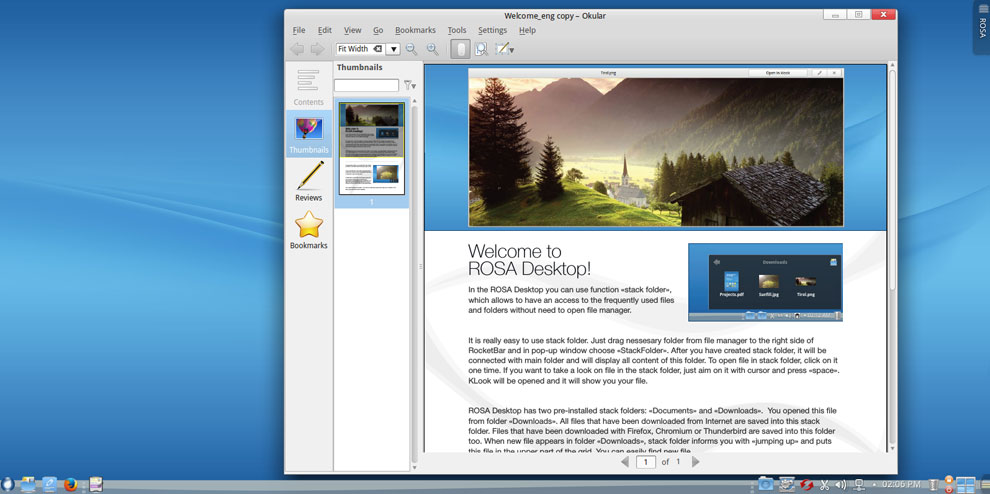
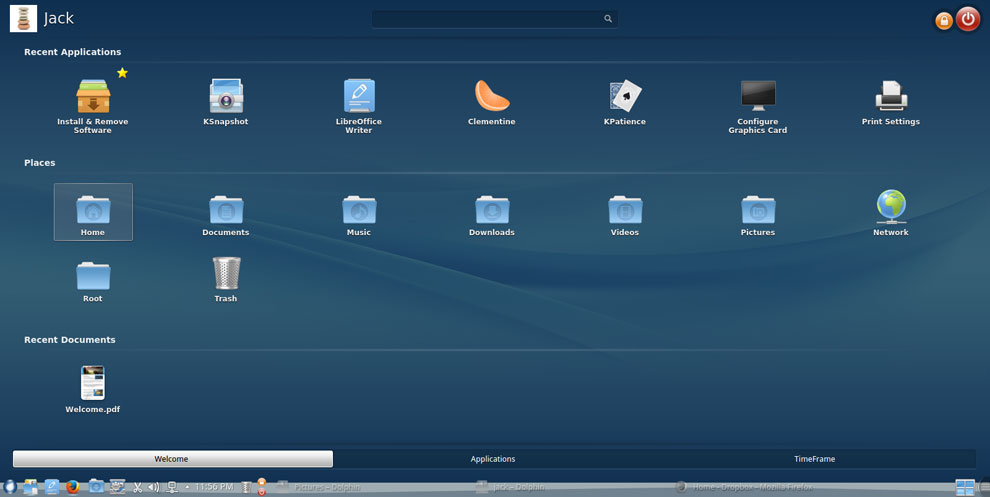
Clicking the menu button in the far left bottom panel bar opens a full-screen menu view with three tabbed options along the bottom edge of the menu window. They provide access to Welcome, Applications and TimeFrame. A search window sits at the top of the screen in the Welcome and TimeFrame screens.
ROSA Desktop
Slingshot-style display
The Rosa Desktop replaces the traditional Linux menu with a three-tabbed full-screen Slingshot-style display.
This approach is a major change not found in standard KDE integration. Rosa developers abandoned the use of Plasma in the SimpleWelcome menu. This brought a decrease in memory usage and significantly improved speed and stability.
The Welcome menu provides a single launch point for applications arranged by category or functionality. Applications displays all installed programs. TimeFrame is a new content visualization tool that allows you to easily monitor your activity at specified dates and return to those documents with a click.

More to Rave About

KDE has its own rich collection of add-on widgets. The Rosa community adds a few of its own to bring more pointed functionality.
StackFolder, a new KDE applet developed by Rosa Laboratory, lets you organize fast access to frequently used folders and files. Use it to create a stack folder by dragging and dropping from the Dolphin file manager to the panel bar's right zone.
The Rosa team did some serious modifications to the standard KDE Dolphin file manager. The developers substantially simplified the main toolbar and removed infrequently used elements.
The developers also decreased the amount of information noise the default menu button on the main toolbar displays. Another key change is the structure of the right-click menu, which is now simpler and more logical.

Impressions and Performance Count

Rosa goes in a direction with the KDE desktop that other distributors have not ventured. Some recent KDE tweaks in newly released distros have muted or removed the prominence of the hot corner buttons that activate key KDE features such as Activities.
Rosa's developers did not eliminate Activities on the desktop. They make its access one of the options in the upper-right corner buttons, along with other system controls.
The bottom right corner button pops up the panel configuration tools and pairs them with the Add Widgets button and a More Settings icon.
Overall, this makes for a very smooth operation. It also simplifies the sometimes overwhelming complexity of KDE.

Software Stronghold

Rosa also does not go overboard stuffing the KDE version with K-era packages when better options are available, so you get essential software, such as the Firefox and Chromium Web browsers, preinstalled.
You also get the Thunderbird mail client, the LibreOffice office suite and the Texlive stack. Rosa Media Player is a default media player.
Rosa includes a set of scientific and educational software, GNU Octave, Maxima, R and a lot of others. A large set of multimedia codecs comes in default installation.

Bottom Line

The Rosa Desktop Fresh R series is one of the most impressive and productive Linux releases I have seen in quite some time. Its performance is top notch.
It gets high marks in all the right places: Installation is flawless, the KDE integration is innovative, and the software is reliable.
KDE is one of the most complex desktop environments, so potential users who are less familiar with the Linux OS should approach the default KDE release with the idea that it is a great computing platform but might not be what they need. Rosa developers offer enough options to meet the skill levels and needs of all user classes.

Want to Suggest a Review?

Is there a Linux software application or distro you'd like to suggest for review? Something you love or would like to get to know?
Please email your ideas to me, and I'll consider them for a future Linux Picks and Pans column.
And use the Talkback feature below to add your comments! 

Weekend Edition: The week's best reads

Weekend Edition: The week's best reads


A collection of some of the best features from the BBC News website this week, with an injection of your comments.
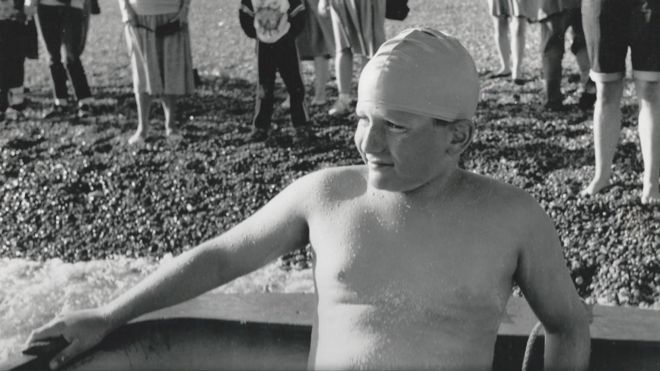
"This is extraordinary," tweeted Louise. "Astounding story," added Elon Dann. No-one has swum the English Channel younger, and no-one ever will. In 1988, 11-year-old Tom Gregory did something few children of his age would even contemplate. And he attributes his successful swim to his inspirational coach John Bullet, the beating heart of Eltham Training and Swimming Club in south-east London. "I loved it," Tom says. "That club changed people's lives."
464 gray line

'I'm still alive'

Noela RukundoImage copyrightABC News
"If someone hasn't already optioned this for a movie, they're seriously missing a trick," tweeted Richard Morgan. The murder of Noela was ordered by her own husband. But the hitmen from Burundi who had been paid to kill her backed out. Noela gave her husband a huge shock when she returned home - he had already told their friends she had died in an accident. "I knew he was a violent man," admits Noela. "But I didn't believe he can kill me. I loved this man with all my heart!"
464 gray line

United States of Anger

Man shouting in front of an American flagImage copyrightiStock
"Remarkably cogent piece," commented M Kop. Americans are becoming increasingly angry, if polls are anything to go by. Stagnant incomes, immigration and a fundamental mistrust of the government are just three of the suggested reasons. The Magazine's Vanessa Barford unpicks the forces which have combined to enrage people in the US.
464 gray line

Coco's rules

Pyjamas at the beachImage copyrightGetty Images
"The photos in this are brilliant," tweeted Alex von Tunzelmann. By World War Two, the craze for pyjamas was fading, with the swimsuit overtaking it as the female beach clothing of choice. Long before that, French fashion designer Gabrielle "Coco" Chanel had decided baggy pyjama-style trousers - complete with a loose-fitting shirt or a sleeveless top - could combine elegance and comfort.
464 gray line

Giving sight

Cornea at National Eye Bank
"An inspiration to us all," commented Noor un Nisa. In many countries donated corneas are in short supply, a situation aggravated by the fact that they have a brief shelf-life. But people in Sri Lanka are so eager to donate their eyes, the country has long harvested more than it needs and has been able to send the surplus to other countries.
464 gray line

Recommended reads from elsewhere